


Оглавление
The global logistics and supply chain landscape is undergoing a massive transformation. As coastal seaports face unprecedented congestion and space limitations, the reliance on inland ports—also known as dry ports or intermodal terminals—has skyrocketed. These inland hubs serve as critical arteries, bridging the gap between coastal shipping routes and deep-inland consumer markets. However, the efficiency of an inland port relies entirely on its container handling equipment. At the heart of this operational efficiency lies a critical decision for terminal operators: choosing the right port gantry crane.
When evaluating container handling systems, the debate almost always narrows down to two heavyweights: the RTG gantry crane (Rubber-Tired Gantry) and the RMG gantry crane (Rail-Mounted Gantry). Both systems are engineered to lift, stack, and transport heavily loaded containers, yet their operational philosophies, infrastructural requirements, and environmental footprints differ significantly.
In this comprehensive guide, we will explore the intricate differences between RTG and RMG gantry cranes, analyze their respective advantages and disadvantages, and provide actionable insights to help you choose the ultimate container-handling system for your inland port operations.
Understanding the Role of the Port Gantry Crane
Before diving into the specific technologies, it is essential to establish what a port gantry crane does and why it is the lifeblood of intermodal logistics. A port gantry crane is a massive piece of material-handling equipment designed to straddle multiple lanes of containers, trucks, or railway tracks. Its primary function is to load, unload, and stack standard ISO shipping containers (TEUs and FEUs) with millimeter precision.
Inland ports have unique operational characteristics compared to traditional coastal seaports. They are typically heavily integrated with national railway networks, heavily reliant on truck turnaround times, and often situated closer to urban or suburban environments. These factors dictate strict requirements regarding:
- Использование пространства: Inland ports often have restrictive, irregular, or narrow layouts.
- Environmental Regulations: Proximity to cities means stricter noise and emission standards.
- Throughput Velocity: Fast transitions from rail to road are prioritized over massive, long-term container storage.
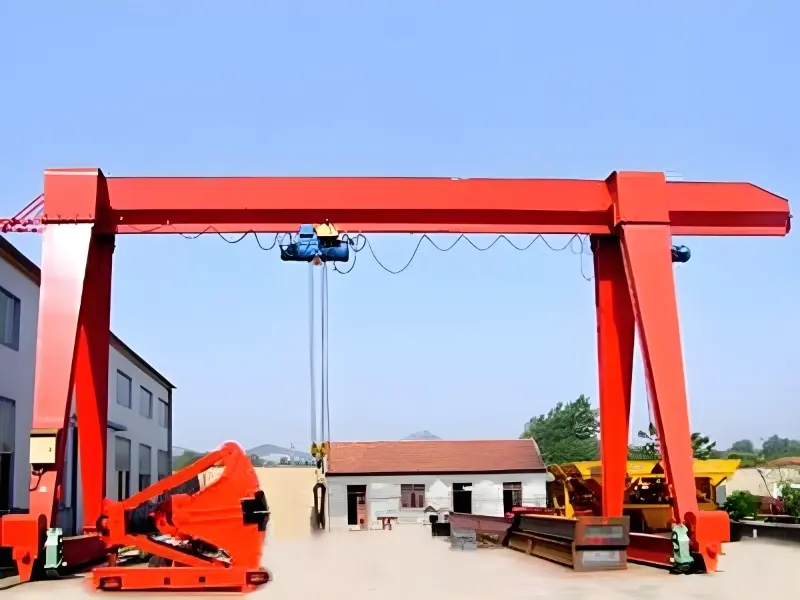
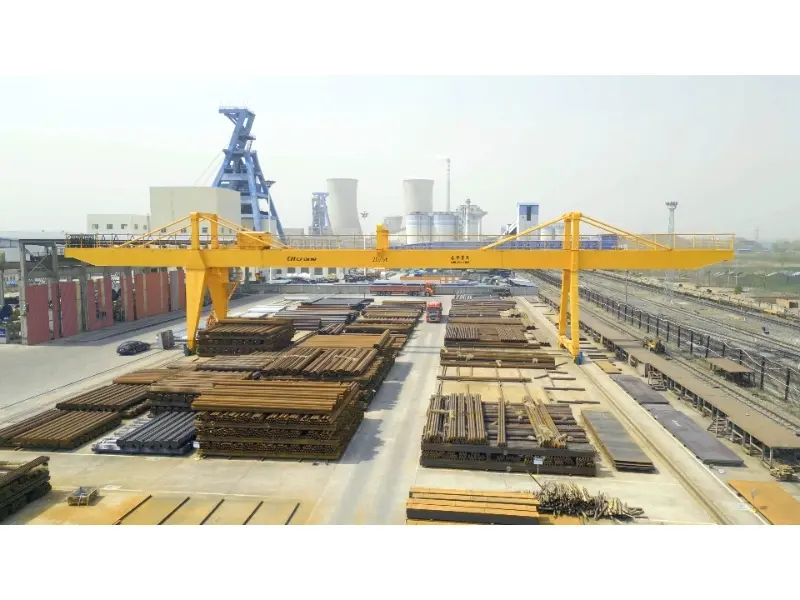
Understanding these unique inland dynamics is crucial when comparing the RTG and RMG systems.
What is an RTG Gantry Crane? (Rubber-Tired Gantry)
An RTG gantry crane is a mobile container handling crane that operates on massive, heavy-duty rubber tires. Because it is not bound to a fixed set of rails, the RTG offers exceptional mobility around the container yard. Traditional RTGs are powered by onboard diesel generator sets (gensets), though modern variations include hybrid, fully electric (e-RTG), and battery-operated models to meet green logistics standards.
The Advantages of RTG Gantry Cranes
- Unmatched Mobility and Flexibility: The most significant advantage of an RTG gantry crane is its ability to transition between different container blocks. If a specific section of the inland port experiences a sudden surge in truck traffic, an RTG can simply be driven over to that block to assist, providing unparalleled operational elasticity.
- Lower Initial Infrastructure Cost: Because RTGs operate on paved concrete or asphalt surfaces, they do not require the expensive installation of heavy steel rails, extensive underground power trenches, or specialized foundations required by rail-mounted systems.
- Adaptability to Yard Layouts: For inland ports that are expanding in phases or possess irregularly shaped land parcels, RTGs can navigate around obstacles and operate in non-linear configurations.
The Disadvantages of RTG Gantry Cranes
- Higher Operating and Maintenance Costs (OpEx): Traditional diesel RTGs consume significant amounts of fuel. Furthermore, the massive rubber tires are prone to wear and tear, requiring costly maintenance and periodic replacement.
- Lower Stacking Density: Because the operator must steer the crane manually and account for wheel deviation, RTGs typically require wider driving lanes. They generally stack containers 1-over-5 or 1-over-6 high, and span 5 to 8 container rows wide, which is slightly less dense than their rail-mounted counterparts.
- Automation Challenges: While automated RTGs (ARTGs) exist, implementing full automation is technically more complex than with rail-bound cranes because the system must constantly correct for tire slip, yard surface irregularities, and steering deviations.
What is an RMG Gantry Crane? (Rail-Mounted Gantry)
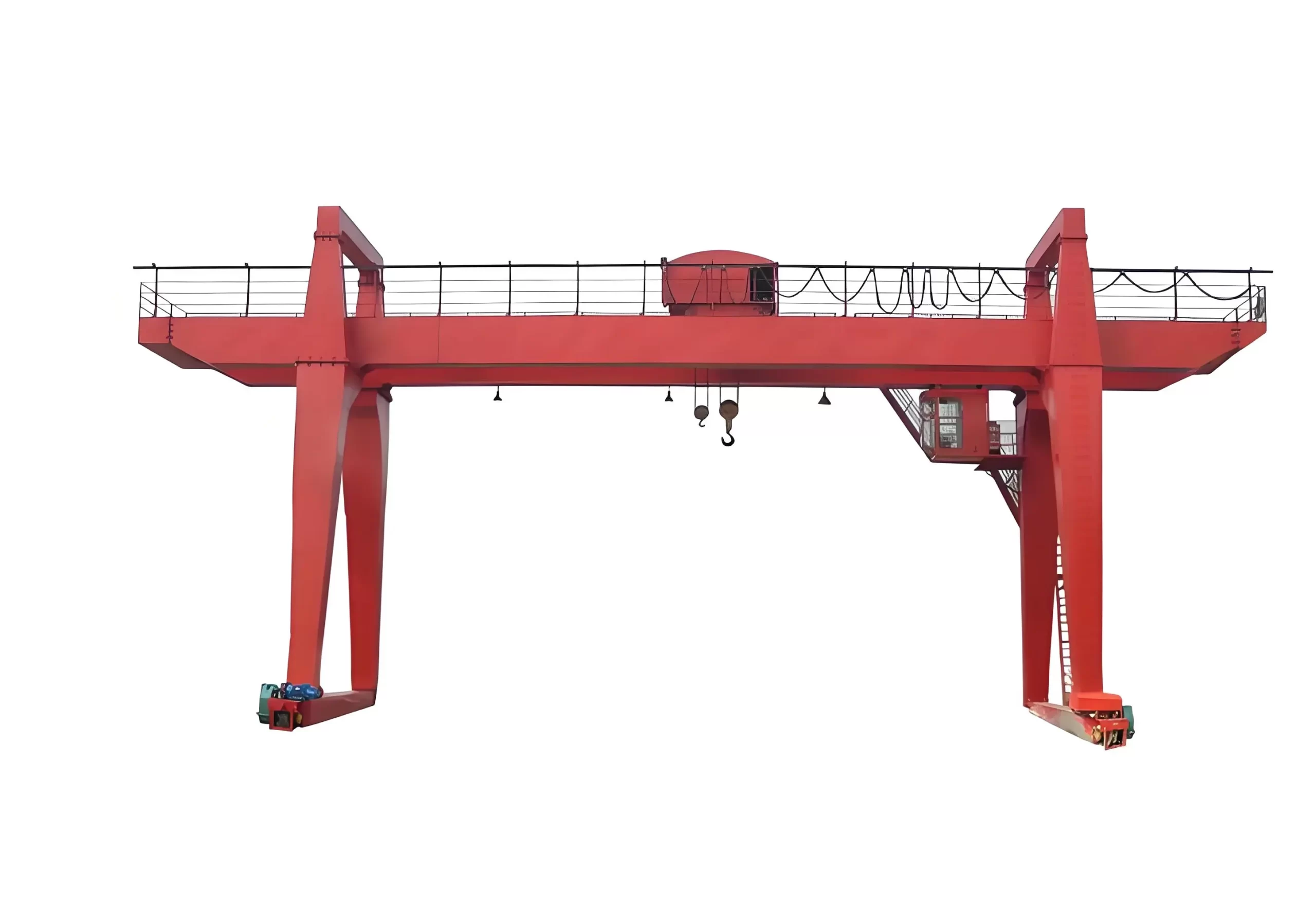
An RMG gantry crane operates on fixed, heavy-duty steel rails embedded into the terminal ground. These cranes are almost exclusively powered by electricity supplied via cable reels or electrified busbars. RMGs are the heavy lifters of the rail-to-road intermodal world, frequently spanning across multiple railway tracks and truck lanes simultaneously.
The Advantages of RMG Gantry Cranes
- Maximum Spatial Efficiency and Stacking Density: Because the RMG gantry crane runs on fixed tracks, it travels in a perfectly straight line without requiring steering lanes. This allows for wider spans (often crossing 12+ rows of containers and multiple railway tracks) and higher stacking heights, maximizing the storage capacity of a given footprint.
- Eco-Friendly and Cost-Effective Operations: Running entirely on grid electricity, RMGs produce zero local emissions and operate with minimal noise. Over the crane’s lifespan, the electrical operating costs are substantially lower than diesel fuel expenses.
- Automation Readiness: RMGs are highly conducive to automation (ARMGs). Since their movement is restricted to an X-Y-Z axis on a fixed track, implementing anti-sway technology, target positioning, and fully unmanned operations is far easier and more reliable.
- Low Maintenance on Travel Mechanisms: Steel wheels on steel rails undergo far less wear and tear compared to heavy-duty rubber tires, resulting in significantly lower maintenance downtime.
The Disadvantages of RMG Gantry Cranes
- Zero Cross-Block Mobility: Once an RMG is installed on a set of rails, it cannot leave them. If one block of the yard is idle while another is overwhelmed, you cannot simply drive an RMG over to help.
- High Capital Expenditure (CapEx): The initial investment for an RMG system is substantial. It requires heavy civil engineering, including laying reinforced concrete foundations, installing tracks, and setting up high-voltage electrical infrastructure.
- Rigid Yard Planning: Implementing RMGs requires meticulous, long-term terminal planning. Any future changes to the yard layout involving the cranes will necessitate expensive and disruptive civil works.
Head-to-Head Comparison for Inland Ports
When optimizing an inland port, the decision between an RTG gantry crane and an RMG gantry crane boils down to assessing your specific terminal dynamics. Let’s compare them across the most critical metrics:
Intermodal Connectivity (Rail vs. Road)
Inland ports heavily feature rail-to-truck transshipment. RMGs are historically the preferred choice for wide rail spans. An RMG can easily span 3 to 4 parallel railway tracks along with several truck lanes, allowing for seamless direct transfer of containers from train cars to heavy goods vehicles. RTGs, while capable of operating over rail tracks, typically have shorter spans and are better suited for the main container storage yard where trucks are the primary mode of transport.
Capital Expenditure (CapEx) vs. Operating Expenditure (OpEx)
If a terminal operator has limited upfront capital and needs to commence operations rapidly, the RTG is the clear winner. The civil engineering required is essentially laying down a heavy-duty reinforced concrete pad. However, if the operator has strong financial backing and is looking at a 20-to-30-year ROI horizon, the RMG wins. The low electricity costs and minimal maintenance requirements of steel-on-steel traction mean the RMG will eventually pay for its high installation costs.
Sustainability and the Push for Green Logistics
With ESG (Environmental, Social, and Governance) goals becoming mandatory in many regions, inland ports are under intense pressure to decarbonize. RMGs are inherently electric and zero-emission. While the RTG market has responded with hybrid-electric and fully electric cable-reel or busbar systems (e-RTGs), these conversions add complexity. An e-RTG must unplug and replug its power source when moving between container blocks, which slightly diminishes its primary advantage: mobility.
Decision Matrix: Choosing the Right System
How do you ultimately decide which port gantry crane is best suited for your inland intermodal terminal? Use the following scenarios as a guiding matrix.
Choose the RTG Gantry Crane if:
- Your inland port has an irregular layout that prevents the installation of long, straight rail lines.
- You require a phased expansion approach and want to avoid massive initial civil engineering costs.
- Your operational bottlenecks constantly shift between different areas of the yard, demanding equipment that can travel dynamically.
- Your container volume is moderate, and extreme high-density stacking is not a strict necessity.
Choose the RMG Gantry Crane if:
- Your inland port acts primarily as a major railway hub with multiple parallel tracks that need to be spanned simultaneously.
- You have limited land available and must maximize stacking density and height to accommodate high throughput.
- You have the capital budget for long-term infrastructure investments to secure lowest-in-class OpEx over the next 20 years.
- You are aiming for a fully automated, unmanned, zero-emission “smart port” environment.
- You are operating in a residential or urban area with strict noise and diesel exhaust regulations.
Sourcing Your Port Gantry Crane
Making the correct choice is only half the battle; partnering with an experienced and technologically advanced crane manufacturer is the other half. For inland terminal operators looking to upgrade their infrastructure or build a new facility from the ground up, consulting with a trusted industry leader is critical.
By exploring a comprehensive range of material handling solutions, such as those found at Girder-Crane’s extensive gantry crane, terminal managers can access tailor-made designs. Whether you need a highly mobile RTG customized for a tight yard, or a massive, wide-span automated RMG for a national railway hub, partnering with experts ensures your equipment matches your precise strategic goals.
The Future of Inland Port Operations
The line between RTG and RMG technologies is beginning to blur as innovation accelerates. We are seeing the rise of ultra-efficient battery-powered RTGs that charge during lowering operations via regenerative braking, almost entirely negating the traditional fuel-cost disadvantage. On the RMG side, advancements in lightweight composite materials and smarter structural designs are reducing the massive wheel-load pressures, somewhat lowering the cost of the foundation work required.
Inland ports will continue to grow as the vital release valves for congested global supply chains. By carefully aligning your yard topology, capital strategy, and throughput targets with the correct container handling technology, you ensure that your terminal remains competitive, profitable, and resilient for decades to come.
Часто задаваемые вопросы
Q1: Can an RTG gantry crane be converted to run on electricity like an RMG?
Answer: Yes. Many terminal operators retrofit traditional diesel RTGs into e-RTGs (Electric Rubber-Tired Gantries). This is typically achieved by installing a motorized cable reel or a conductor bar system (busbar) along the container block. While this significantly reduces fuel costs and emissions, the crane must disconnect from the power grid and use a smaller auxiliary diesel engine or battery pack when moving between different blocks, which slightly limits its rapid mobility compared to standard diesel RTGs.
Q2: Why do RMG gantry cranes provide higher stacking density than RTGs?
Answer: An RMG operates on fixed steel rails, meaning its travel path is perfectly linear and mathematically precise. Because there is no risk of the crane deviating from its path, operators do not need to leave extra width for steering lanes. This allows containers to be stacked much closer together. Furthermore, the robust stability of rail foundations allows RMGs to safely stack containers higher (often 1-over-6 or higher) and span wider distances than most RTGs.
Q3: Which crane type is better suited for full terminal automation?
Answer: While both can be automated, the RMG gantry crane is fundamentally better suited for full automation (creating an ARMG system). Because its movements are restricted to fixed steel tracks, the variables for navigation are drastically reduced. Automating an RTG (ARTG) is more complex because the system software must constantly calculate and correct for rubber tire slippage, uneven yard surfaces, and slight steering deviations, requiring much more sophisticated and expensive sensor arrays.